Every time a phone provides driving directions, a surveyor measures a property boundary, or a scientist tracks the movement of a tectonic plate, satellites thousands of kilometers above Earth may be involved. The technology behind these measurements is called GNSS, or Global Navigation Satellite System.
GNSS is actually a broader term than GPS. GPS, operated by the United States, is one GNSS constellation. Other systems include Europe's Galileo, China's BeiDou, and Russia's GLONASS. Modern receivers can often communicate with several constellations, providing more satellites and improving positioning reliability.

How Does GNSS Find Your Location?
GNSS satellites continuously transmit radio signals containing extremely precise timing and orbital information.
A receiver—such as your phone—records when a signal arrives. Because radio waves travel at approximately the speed of light, the receiver can estimate its distance from a satellite using:
Distance ≈ speed of light × signal travel time
Knowing your distance from one satellite is not enough to determine your location. Instead, a GNSS receiver simultaneously measures signals from multiple satellites.
At least four satellites are normally needed to solve for four unknowns: your three-dimensional position—latitude, longitude, and altitude—and the timing error in the receiver's clock.
This process is commonly called trilateration.
Why Isn't Your Phone Perfectly Accurate?
GNSS positioning sounds straightforward, but the signals encounter several problems while traveling to Earth's surface.
The ionosphere and troposphere can delay radio signals. Satellite orbit and clock uncertainties introduce additional errors. Buildings, mountains, and other objects can reflect signals before they reach a receiver, producing an effect called multipath.

This is why a smartphone might place you on the wrong side of a street even though GNSS itself can achieve much greater precision.
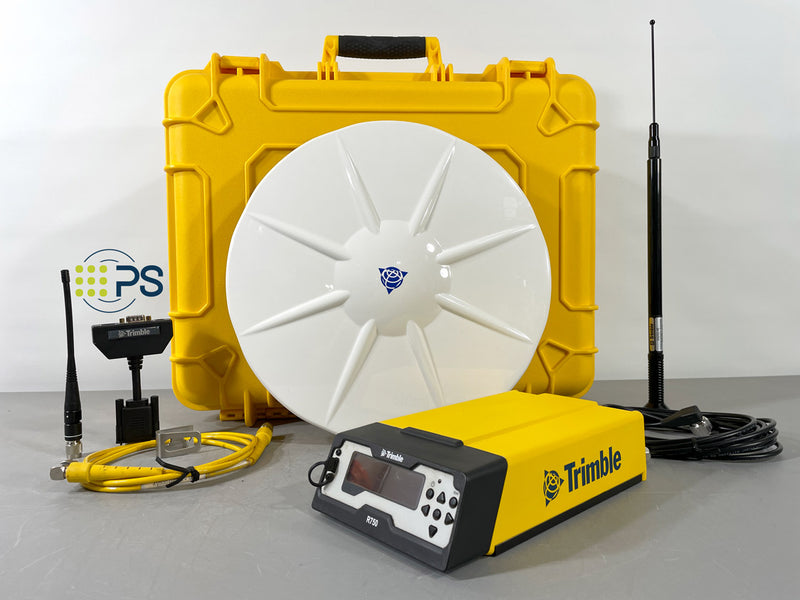
Professional geodetic receivers use sophisticated techniques to correct these errors. Differential GNSS compares observations from receivers at known locations, while Real-Time Kinematic (RTK) positioning uses measurements of the signal's carrier wave to achieve centimeter-level positioning under favorable conditions.
GNSS Can Measure a Moving Earth
GNSS becomes particularly interesting when it is used for geodesy.
Permanent GNSS stations installed on stable ground continuously record their positions. By comparing measurements across months or years, scientists can detect extremely small movements of Earth's crust.
For example, tectonic plates may move only a few centimeters each year. That movement sounds insignificant, but GNSS stations can measure it. Networks of receivers therefore allow geodesists to map plate motion and study how strain accumulates around faults.
After major earthquakes, GNSS can also reveal how far the surface moved.
Measuring Glaciers, Volcanoes, and Sea Level
GNSS has applications far beyond navigation.
Researchers can install receivers on glaciers to measure how quickly the ice flows. Stations around volcanoes can detect ground inflation or deflation caused by magma moving underground. GNSS measurements are also combined with tide gauges to separate changes in ocean height from movement of the land itself.
Even Earth's atmosphere can be studied using GNSS. Scientists analyze how satellite signals are delayed as they travel through atmospheric water vapor, providing information useful for meteorology.
More Than a Navigation System
GNSS has effectively created a continuously available global measurement framework.
A technology most people encounter as the blue location dot on their phones can measure processes occurring across an extraordinary range of scales—from tracking a moving vehicle to detecting the slow deformation of an entire continent.
For geodesy, that is what makes GNSS so powerful. It doesn't simply tell us where something is. By repeatedly measuring position with extreme precision, it tells us how Earth itself is moving and changing over time.